Tuesday, 25 December 2018

Photoshop-To-Create-GIFs

The Bouncing Heart

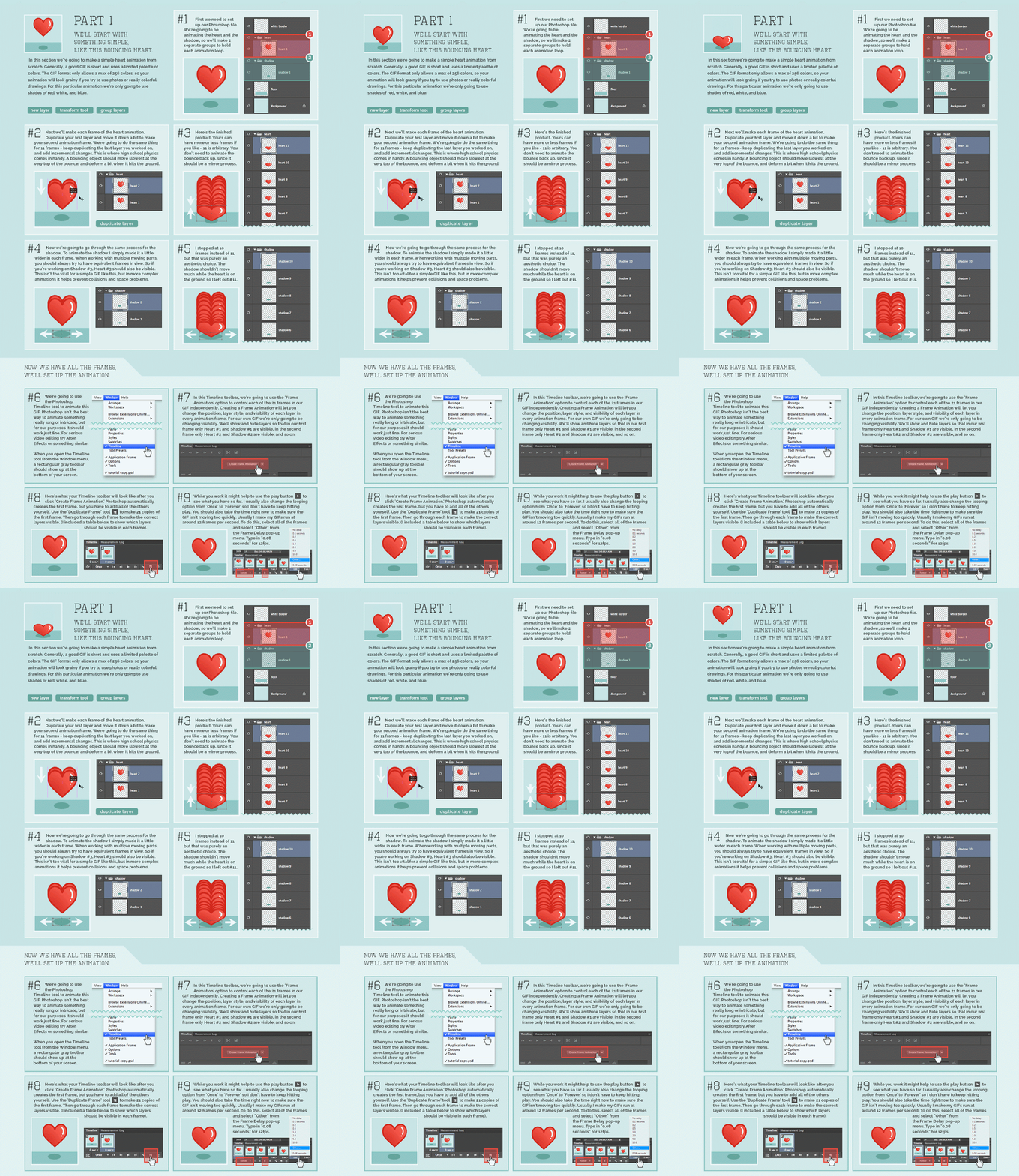
Since a short GIF is always good and uses limited colors. Your GIF might turn out to be grainy if you use too many colors. So it is better to create a bouncing heart animation using only three colors – red, white, and blue. 
  • Create a new PS file, and three separate layers, one with a heart, one consisting a shadow and third with a floor area
  • Now, to create a bouncing effect, start duplicating the layer with hearts until you get eleven frames of hearts
  • Do the same with the shadow, but increase it width-wise in each frame
  • Make sure you are keeping all the equivalent frames in view, like shadow#3, heart#3
  • The shadow should not move when the heart touches the ground, so, 10 frames will be just perfect instead of 11
  • The animation frame is ready now, and it is time to apply animation
  • Go to Windows, select “Timeline” and a grey rectangular bar will pop up at the bottom of the screen
  • Now choose “Frame Animation” to control all 21 frames independently
  • Although “Frame Animation” is used to change the position, visibility and layer style in each frame, you just need to change the visibility here
  • Show and hide layers in a way that Heart#1 and Shadow#1 are visible together in the first frame and Heart#2 and Shadow#2 are visible in the second frame
  • The first frame will be automatically created but the rest need to be done by you
  • You can use “Duplicate Frame Tool” to create 21 copies of the first frame and then go through each frame to ensure the right layers are visible
  • To check the output, click on the play button, or choose “Once” to “Forever” to avoid hitting the play button again and again
  • Adjust the timing at which you want your GIF to be moving
  • You can do this by selecting all the frames and then choosing the “Option” – “Other from Frame Delay Pop-Up” and type in the time.

Monday, 4 June 2012

How to clean Radiator


Instructions


    • 1
      Allow the car to cool for 12 hours before attempting to clean the radiator. Unscrew the drain cap at the bottom of the radiator and allow the radiator fluid to drain into the drain pan.
    • 2
      Close the plug and fill the radiator with water. Turn on the car and run the engine until the water circulates completely through the engine. You should be able to see steam. Allow the engine to cool for one or two hours. Repeat the draining and water filling process one more time. Drain the water from the radiator and allow the engine to cool.
    • 3
      Fill the radiator with a radiator system flush. Turn on the heater and run the engine for about 10 minutes. Follow the instructions on the flush bottle if they differ. Some flushes have a slightly different procedure.
    • 4
      Drain the radiator, then fill with water. Run the water through the engine, then drain it. Repeat the flush process one more time.
    • 5
      Fill the radiator with antifreeze. Fill the radiator with 50 percent antifreeze and 50 percent water. Run the engine and heater one last time for about 10 minutes to flush the antifreeze through the system.

      Tips & Warnings
  • Never touch a hot radiator, or put your face or other skin close to the radiator while it is heated. The steam from the radiator can cause serious injuries and burns.

Saturday, 2 June 2012

Clear your skin with 7 tips


            Clear skin tip 1: Ditch the chemicals

It can be tempting to reach for chemical peels and ingredients such as salicylic acid to help clear up problem skin. However, many chemical-based skin products not only contain potentially harmful ingredients, they can also excessively dry out skin and exacerbate skin problems. For a gentler approach to fighting acne, opt for natural spot-fighting ingredients such as tea tree oil or manuka honey.  Manuka honey not only has antimicrobial and antiseptic properties to fight spots, it also has the benefit of being able to reduce the scarring and marks left by spots.


Woman with beautiful skin

            Tip 2: Use spot-fighting makeup

We all know what it’s like to have a bad skin day when you just want to hide away under layers of makeup. However, while makeup can temporarily disguise the look of spots, it can also make the problem much worse. For confidence-boosting coverage that won’t cause flare-ups, make sure you opt for non-comedogenic makeup that won’t clog pores. To further increase the spot-fighting powers of your cosmetics, try using mineral makeup containing zinc oxide, which will fight against acne-causing bacteria.

            Tip 3: Sip spearmint tea

Acne is generally caused by hormones called androgens, which can over-stimulate the sebaceous glands leading to oily skin, blocked pores and spots. To counteract these effects, oral contraceptives are often prescribed to women suffering from acne. However, while beneficial for clearing spots, these contraceptive pills can have inconvenient and even dangerous side effects. Luckily, research suggests that spearmint tea has similar anti-androgen properties, which could help reduce acne and hormone imbalances in women.

            Tip 4: Reduce your skin’s contact to bacteria

You may be surprised at how often your skin comes into contact with dirt and germs that can lead to acne. During the time you are asleep, your pillow comes into contact with makeup, skin oils and saliva, making it a breeding ground for bacteria that can worsen acne. Likewise, unwashedmakeup brushes can spread bacteria to your skin. To minimise your skin’s contact to bacteria, make sure you wash makeup brushes every two weeks and change your pillowcase regularly. Also, avoid touching your face as much as possible and clean your phone with antibacterial wipes before making calls.

            Tip 5: Cleanse your skin properly

If you suffer from oily or acne-prone skin it can be tempting to over-cleanse your skin to dry out oils and kill bacteria. However, cleansing your skin too frequently or using harsh cleansers can dry out your skin, causing flakiness which can clog pores. It can also cause your skin to produce more oils to compensate. Instead, wash your skin twice a day with a gentle, PH-neutral cleanser so as not to destroy the acid mantle of the skin, which protects against moisture loss and bacteria. Remove the cleanser with a muslin cloth to lightly exfoliate the skin.

            Tip 6: Change your diet

Eating a balanced diet with plenty of nutrients and antioxidants is one of the key factors behind beautiful looking skin. However, there are also certain foods you can cut back on or eat more of in order to help get rid of spots. Research suggests that dairy is a major precursor of acne for many people due to the hormones it contains. Plastic water bottles and food packaging can also leach out chemicals which can lead to hormone imbalance. Swap packaged foods for fresh, skin-friendly produce including lots of fruit and vegetables and foods rich in omega-3 fatty acids.

            Tip 7: Find ways to deal with stress

Research findings published in the journal Archives of Dermatology suggest that high stress levels can significantly worsen acne. It is thought that this may be due to the fact that stress stimulates the production of hormones which stimulate oil production in the skin’s sebaceous glands. Stress is also thought to instigate the release of chemicals which can lead to inflammation. To help keep your skin clear and spot-free, try to find healthy ways to deal with stress such as exercise, meditation or pampering. Try to talk through problems with someone else as well to help relieve any worries.

Sunday, 6 May 2012

WHAT ARE BLOOD TYPES?


Everybody has a blood type. The most common blood type classification system is the ABO (say "A-B-O") system discovered by Karl Landsteiner in the early 1900s. There are four types of blood in the ABO system: A, B, AB, and O. Your blood type is established before you are born, by specific genes inherited from your parents. You receive one gene from your mother and one from your father; these two combine to establish your blood type. These two genes determine your blood type by causing proteins called agglutinogens (a-GLOO-tin-a-gins) to exist on the surface of all of your red blood cells.
There are three alleles or versions of the blood type gene: A, B, and O. Since everybody has two copies of these genes, there are six possible combinations; AA, BB, OO, AB, AO, and BO. In genetic terms, these combinations are called genotypes, and they describe the genes you got from your parents.
In addition to the proteins (agglutinogens) existing on your red blood cells, other genes make proteins called agglutinins (a-GLOO-tin-ins) that circulate in your blood plasma. Agglutinins are responsible for ensuring that only the blood cells of your blood type exist in your body.
Your genotype determines your blood type.

The agglutinogen produced by the O allele has no special enzymatic activities. However, the agglutinogens produced by the A and B alleles do have enzymatic activities, which are different from each other. Therefore people whose genotype is OO are said to have type O blood, meaning the agglutinogen on their red blood cells doesn't have any enzymatic activity. People with Type O blood have agglutinins a and b in their blood plasma. Agglutinin a helps the body destroy any type A blood cells that might enter the circulation system. Agglutinin b helps the body destroy any type B blood cells that might enter the circulation system.

'Supermoon' lights up the sky


The biggest full moon of the year rises on May 5 as Earth's only satellite swings into its perigee, or closest approach to Earth. This so-called "supermoon" appears extra big and extra bright.

Taking Screenshots in Mac OS X


Shortcuts


Command-Shift-3: Take a screenshot of the screen, and save it as a file on the desktop
Command-Shift-4, then select an area: Take a screenshot of an area and save it as a file on the desktop
Command-Shift-4, then space, then click a window: Take a screenshot of a window and save it as a file on the desktop
Command-Control-Shift-3: Take a screenshot of the screen, and save it to the clipboard
Command-Control-Shift-4, then select an area: Take a screenshot of an area and save it to the clipboard
Command-Control-Shift-4, then space, then click a window: Take a screenshot of a window and save it to the clipboard.

Sunday, 6 December 2009

How to Build Trust?


Trust is so fragile that is hard to put back to its original state when broken. My simple tips how to build trust is dedicated to kids and their parents as well.


Tips How To Build Trust:

1 - Never tell a lie, always tell the truth. And, say it kindly and tactfully.

2 - Be real, do not act like somebody you are not.

3 - Do not gossip about other people’s life. The one you are talking to may think you are gossiping her at her back. The worst scene is – if she pass what you said to other people too.

4 - Never betray a confidence. Do not tell the secrets confided to you.

5 - Keep all the promises you made. If you cannot keep a promise, better not to promise at all.

6 - When you borrow something, always return it as soon as possible.

Wednesday, 2 December 2009

Tuesday, 10 November 2009

Eid al-Adha Meaning of "The Festival of Sacrifice"

What is Eid al-Adha?

At the end of the Hajj (annual pilgrimage to Mecca), Muslims throughout the world celebrate the holiday of Eid al-Adha (Festival of Sacrifice). In 2009, Eid al-Adha will begin on approximately November 27th, and will last for three days.

What does Eid al-Adha commemorate?

During the Hajj, Muslims remember and commemorate the trials and triumphs of the Prophet Abraham. The Qur'an describes Abraham as follows:

"Surely Abraham was an example, obedient to Allah, by nature upright, and he was not of the polytheists. He was grateful for Our bounties. We chose him and guided him unto a right path. We gave him good in this world, and in the next he will most surely be among the righteous." (Qur'an 16:120-121)

One of Abraham's main trials was to face the command of Allah to kill his only son. Upon hearing this command, he prepared to submit to Allah's will. When he was all prepared to do it, Allah revealed to him that his "sacrifice" had already been fulfilled. He had shown that his love for his Lord superceded all others, that he would lay down his own life or the lives of those dear to him in order to submit to God.

Why do Muslims sacrifice an animal on this day?
During the celebration of Eid al-Adha, Muslims commemorate and remember Abraham's trials, by themselves slaughtering an animal such as a sheep, camel, or goat. This action is very often misunderstood by those outside the faith.

Allah has given us power over animals and allowed us to eat meat, but only if we pronounce His name at the solemn act of taking life. Muslims slaughter animals in the same way throughout the year. By saying the name of Allah at the time of slaughter, we are reminded that life is sacred.

The meat from the sacrifice of Eid al-Adha is mostly given away to others. One-third is eaten by immediate family and relatives, one-third is given away to friends, and one-third is donated to the poor. The act symbolizes our willingness to give up things that are of benefit to us or close to our hearts, in order to follow Allah's commands. It also symbolizes our willingness to give up some of our own bounties, in order to strengthen ties of friendship and help those who are in need. We recognize that all blessings come from Allah, and we should open our hearts and share with others.

It is very important to understand that the sacrifice itself, as practiced by Muslims, has nothing to do with atoning for our sins or using the blood to wash ourselves from sin. This is a misunderstanding by those of previous generations: "It is not their meat nor their blood that reaches Allah; it is your piety that reaches Him." (Qur'an 22:37)

The symbolism is in the attitude - a willingness to make sacrifices in our lives in order to stay on the Straight Path. Each of us makes small sacrifices, giving up things that are fun or important to us. A true Muslim, one who submits his or herself completely to the Lord, is willing to follow Allah's commands completely and obediently. It is this strength of heart, purity in faith, and willing obedience that our Lord desires from us.

What else do Muslims do to celebrate the holiday?

On the first morning of Eid al-Adha, Muslims around the world attend morning prayers at their local mosques. Prayers are followed by visits with family and friends, and the exchange of greetings and gifts. At some point, members of the family will visit a local farm or otherwise will make arrangements for the slaughter of an animal. The meat is distributed during the days of the holiday or shortly thereafter.

Miracle of Kaaba English Version on Vimeo
http://www.youtube.com/watch?v=xxSECWeVoKc

http://islam.about.com/od/hajj/a/adha.htm
Wednesday, 28 October 2009

Poetry

Mujhe ye dukh nahi k mai mar jaoga ek din,

***Dost***

Mujhe dukh hy k mere bad us ki khusiyon ki dua kon karega.

English:

I am not sad, one day i will leave this world,

***My Friend***

I am sad because after me no one pray for your happiness!

Monday, 26 October 2009

How to Soothe a Sore Throat?

Sore throats are not just painful, they can keep us from communicating. No one likes to talk while suffering from a pained or scratchy throat. Fortunately, you often can relieve the discomfort without taking any drugs.

Instructions
Step 1
Drink 4 to 6 glasses of water per day. Don't smoke or drink alcohol. Avoid very hot drinks and sugary colas because they can irritate your throat's delicate membranes.

Step 2
A hot cup of water with 2 teaspoons of honey and the juice of half of a lemon is very effective. The honey soothes, and the citrus of the lemon kills germs.

Step 3
Add 2 teaspoons of apple cider vinegar to a cup of warm water. Gargle a mouthful, spit it out and then swallow a mouthful. Repeat until the liquid is gone. Both the warm water and the vinegar will kill the germs infecting your throat.

Sunday, 25 October 2009

STEPS IN PRINTING & BID PROCESS

STEPS IN PRINTING & BID PROCESS


Key Players: Designer
Coordinator/Project Director,
Printer (Printing press)

TIMELINE:
Planning: 1 weeks
Working: 1-2 weeks
Printing: 1-2 weeks
Total: 3-4 weeks (Best schedule: 4-5 weeks)

STEPS (brief):
1. PLANNING: Finalize Copy
2. PLANNING: Provide Art or decide to create NEW artwork
3. PLANNING: Brainstorm image/tone you want
4. PLANNING: Meet with Designer & Send Bid to printers
5. WORKING: Arrange/Coordinate for NEW photo
6. WORKING: DESIGNER WORKS ON ARTWORK
7. WORKING: Proofing routing #1, #2, and #3
8. WORKING: Final Proofing with Signature of the Client
9. FINAL: sending file to Printing Press
10. FINAL: Printer sends back proof
11. FINAL: Press check & printing
12. FINAL: Product delivery
13. FINAL: Pay invoice

STEPS (detailed):
1. PLANNING: Finalize Copy (very important to get ONE word.doc to designer as CLOSE TO ‘perfect’ copy as possible;

HOT TIP: Look at earlier brochures OR ask for a word.doc formatted template; follow format EXACTLY – even outlining subheads, bolded 1st sentences, etc. – then send copy as attached word.doc.)

2. PLANNING: Search for ALL available ART/PHOTOS (get signature approval, if necessary). Have hard copy image handy to deliver for scanning.


3. PLANNING: ART! Brainstorm art and tone of brochure. WHO and WHERE a NEW photo (or graphic) can be created that you may want as your “campaign image” (an image that “sells” your conference, program, etc.) Any idea helps, but think of your AUDIENCE; and think of PEOPLE IN NATURAL SETTING (example: a smiling, helping a patient, Happy family, protection, ‘real-world’ experience).

4. PLANNING: Meet with Designer to discuss the layout, and deliver the copy. (FUN BRAINSTORMING over ART/IMAGE can take place here.)


5. WORKING: Arrange/Coordinate for photo OR assist in developing graphic art. (Simple: if you have art, provide it. IF NOT, This is a two-step process IF you use people for NEW PHOTOS: 1. You set-up the people, locations, and/or props for the photographer – either staff media specialist, who also has a camera – to take a “photo-shoot.” This should be simple, fast, and conceptual. 2. Alert people that their signature on a RELEASE FORM is necessary.)


6. WORKING: Designer works on Artwork – find pictures, scans art, creates cover “campaign image, “brand” standards (CMYK colors, etc), edits, finalizes. After 1-week, delivers PDF to proof (this is an electronic file to be sent to you; COLOR PROOFS also available upon request; please keep limited.)

7. WORKING: You print out proof and make HARD COPY changes or EMAIL specific updated copy changes to David. It is very important edits are clear, and have been checked all authorized people.

8. WORKING: Designer will make FINAL PDF or picture image, and send back for FINAL Approval to client.

ALSO: Now you can start the BID process after final specifications are settled.


9. FINAL: Designer then sends FINAL PDF & Files/graphics to printer

10. FINAL: Printer sends back COLOR proof and/or PDF for final approval

11. FINAL: Both Designer and Coordinator HAVE OPTION to come to PRESS CHECK (standing next to printer as first piece rolls out)


12. FINAL: Printer delivers pieces where YOU want them

13. FINAL: You receive invoice, and pay in 30 days

Wednesday, 21 October 2009

ABS ... What is it?


ABS is an abbreviation for Anti-lock Braking System. It was designed to help the driver maintain some steering ability and avoid skidding while braking.

ABS was introduced in the mid -1980s and has become "standard" equipment on the majority of vehicles sold in Canada. ABS in cars and most Multi-purpose Vehicles (MPV’s) works on all four wheels. This promotes directional stability and allows steering while maximizing braking.

The ABS in most pick-up trucks works only on the rear wheels, which promotes directional stability only. However, there are some available with ABS on all four wheels.

Control under heavy braking
ABS allows you to maintain control of the vehicle. Since four-wheel ABS prevents all wheels from skidding, it allows you to steer the vehicle and still maintain braking.

How does it work?
ABS uses wheel speed sensors to determine if one or more wheels are trying to lock up during braking. If a wheel tries to lock up, a series of hydraulic valves limit or reduce the braking on that wheel. This prevents skidding and allows you to maintain steering control.

Why do I want or need this?
In a recent Canadian Automobile Association survey of some 1700 members, 66% correctly associated ABS with vehicle stability in an emergency, and 53% correctly stated that ABS allows the driver to steer while braking.

Since the ABS will not allow the tire to stop rotating, you can brake and steer at the same time. The braking and steering ability of the vehicle is limited by the amount of traction the tire can generate.

If you demand steering while braking, the 100% of traction that the tire can generate will be divided between both tasks. For example, if you require 50% for steering then there is 50% of available traction left for braking. If you require 10% for steering then there is 90% left for braking. Be aware that 100% traction on a dry road is a great deal more traction than 100% traction on ice! Therefore, your vehicle is unable to steer and brake as well on a slippery surface as it can on a dry road.

What is cruise control

Definition:

An optional feature that keeps your car cruising at a preset speed unless overridden by the brake pedal.


A system that maintains a vehicle at constant set speed, usually until the brake or accelerator is pressed.


A device that, when set by the driver, will hold the car at the chosen speed.


A system which automatically regulates vehicle speed, making it possible to drive without continually holding down the accelerator pedal.

How pantone works

A graphic designer is designing an identity package. She looks through a Pantone solid color formula guide (based upon the Pantone Matching System) until she finds a red color she likes.

http://www.colorguides.net/pms_books.html

What is Pantone?

There are many different color matching systems availlable today, but by far, the most popular in the printing industry is the Pantone Matching System